
Hello, friends and fans! 
As you know by now, I’m a huge Beetle fan and pretty much always have been! Last week I wrote an article “My History With VW Beetles!” which pretty much sung the little car’s praises… but I’m also a practical person, and a realist, so that doesn’t mean there aren’t things about the VW bug that I don’t like – or absolutely loathe and wouldn’t change in a heartbeat, given the opportunity! Here then, is my list of gripes about the bug!
The bug you see, is a simple, basic and very hardy design… but some parts of it are simply not designed to be convenient or easy to work on!
Working On The Engine:

One of the biggest gripes I have about the design of the Beetle is that when you’re working on the engine, you have to take the bonnet off whilst performing certain repairs on the motor! There simply is no other way – other than to first drop the engine out of the car before working on it!
Examples of the sort of work that would make this necessary include relatively minor tasks like removing the alternator, fan housing or oil cooler! The reason for this consternation is, that in order to detach the fan housing and lift it off the motor, you need to clear the bonnet hinge mountings, which block its vertical path! The alternator or generator is mounted to the front of the fan housing with four bolts, and in order to access the lower two bolts, you need to lift it clear of the inlet manifold – which is nigh on impossible with the hinge brackets in the way! You also can’t remove the alternator without removing the whole thing out of the engine bay anyway, to clear the inlet manifold and alternator stand! The same is true for the oil cooler, which is situated underneath the fan housing!
The designers obviously figured that since the motor is only anchored by four bolts and tethered by a fuel line and accelerator cable, it would be easier to just drop the engine in order to access these parts – and yet even that is the source of another gripe I have with VW: why force the removal of the motor or the bonnet to perform simple maintenance tasks?
In theory it’s a fairly simple job to remove and replace the Beetle bonnet – and in a sense it is – in theory. It’s only four bolts to secure the hinges and six to secure the hinge mounts to the body – but lining the whole thing up so it closes properly without scraping paint off these components involves two elephants and some fancy language! Then on top of that, the spring which keeps the bonnet up when its open needs to be refitted afterwards – which can be a real bitch without some kind of anonymous special VW workshop tool! Last time I had to take off the bonnet that thing gave me so much gyp getting it back in, I nearly gave up on that spring altogether!
That Crappy Alternator Pulley!
The Beetle generator slash alternator design is a venerable one dating back to the 1930s – like most of the Beetle – and when it works, it works – but when it gives your trouble, it can become a real nightmare!
Frankly, one of the long-running issues I’ve had with Dolly (and several previous bugs) is that crappy alternator pulley design! One little issue, say a stripped alternator drive shaft which prevents tensioning of the fan belt and allows the nut to creep off – and the whole pulley becomes totally useless! In fact, Dolly’s one used to fall spectacularly apart at strange and inconvenient moments while tootling along even at low engine speeds! This can be a serious problem, because the alternator also drives the cooling fan inside the fan housing (amusingly called the “doghouse”) and if the alternator stops turning, the fan does as well. Since the bug is air-cooled, it doesn’t take a lot of brainpower to figure out that you’re going to be stuck in a dark corner dancing without any music.
Back in 2015, I thought I’d solved this problem when I replaced the venerable old 6 volt generator with a brand new 12v alternator, stand and fancy chrome pulley. Trouble was, the Beetle alternator uses a key system to hold the pulley stable on the shaft, and it wasn’t very long before the key wore out and allowed the pulley to move around the shaft, completely destroying the key and the slot it fitted into! In the meantime, the pulley also moved closer towards the body of the alternator, and the edge cut a groove into the face itself! A little longer, and the alternator would’ve been completely written off! In the interim, I also carried out numerous repairs to this decrepit system, but finally just welded the back part of the pulley to the alternator shaft! It’s been fine ever since (touch wood)! Why couldn’t they just have used a notched axle shaft instead, or even a pair of sprockets and a bicycle chain?
Safety Last!
Putting the fuel pump and distributor right next to each other might have made a little sense on paper – after all, the drives for these two devices are in the same area, but I wonder if any of the designers ever considered just what happens if flammable liquid sprays onto high tension electrical contacts or leads on the distributor! Woof! That has to be one of the top five most daft ideas I’ve ever seen on any car! Even after thirty years of tinkering on these cars, I’m still not comfortable with the close location of these two items to each other – in fact, it makes me a little hysterical! The best anyone can do about it is to either replace the mechanical fuel pump with an electric unit somewhere else in the engine bay, or to just ensure the fuel lines and clamps are secure and in good condition – and carry a fire extinguisher in the car!

Nuts To This!
Hard to reach nuts and bolts! Mostly it’s fairly simple and straightforward to access the nuts, screws and bolts on the Beetle. Mostly. The most conspicuous exceptions are the four famous nuts VW said make it so “simple” to drop the Beetle motor onto the floor. In truth, you need to have either thin spidery arms to reach the top two above the bell-housing behind the fan housing with not one, but two spanners, or you need to first remove the entire upper part of the engine, including the fan housing first!
There’s also a ton of other hard to reach nuts and bolts, including the ones securing the intake manifold, and all the ones holding the cooling tin-ware together at the flywheel end of the motor – not to mention the two lower bolts holding the alternator in the fan shroud!
Non Self-Adjusting Brakes:
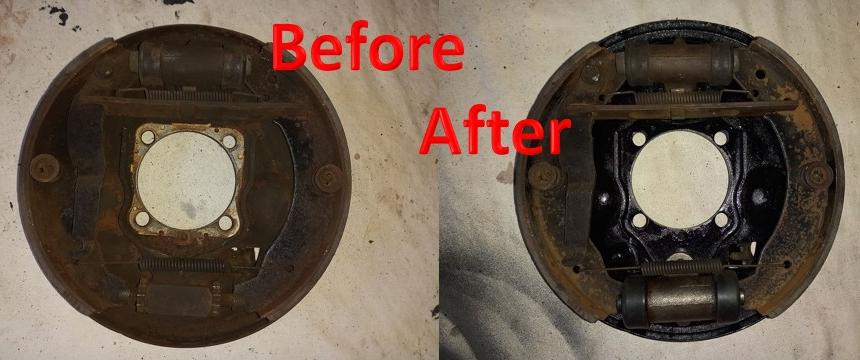
The earlier beetles (and all of them made in South Africa) all had drum brakes front and rear. That was fine, since they stopped well enough if they were adjusted properly and there were no leaks in the brake lines or cylinders… and there’s the rub – unlike the drum brakes in newer cars, they didn’t self-adjust! That means that every so often, you’d notice your brakes getting slacker and less effective, and then you’d have to figure out how the hell to adjust them yourself since most mechanical workshops these days either don’t know how, or don’t want to know! Getting the balance just right so your car doesn’t pull to one side while braking is one of the issues facing owners. Self-adjusting drum brakes have been around a good long while – you’d think VW would’ve updated and upgraded the brakes of later models of Beetle/Kombi/Karmann Ghia etc., so that they could be retrofitted to older bugs!
Instead, a lot of Beetle owners are having to spend thousands on installing fancy disk-brake kits – or those like me (who simply have better things to do with R20,000) design their own adaptations to make their drum brakes self-adjusting! (Stay tuned on that one by the way, I’ll post about it when I’m done!)
Older Bugs Don’t Get Central Locking!
Fitting central locking to earlier models is next to impossible, unless you can figure out how to wrap the simple remote-controlled solenoid system employed on newer cars with the locking pin door lock arrangement around the older system! Yes, the older system is charming and refreshingly different, but the differences in leverage, load strength and length of travel makes the problem of adapting a modern system to fit it a real headache! If I ever get around this one, I’ll be sure to let you know!
Let The Rust In:
The older models have only the air vents under the back window and nothing else. This made sense, since it left fewer places for water to get in. Unfortunately, in later years, VW added some more silly air vents around the car – on the sides and in the engine covers and front bonnets of later models that let water – and the rust, in. Aside from wet engines and starting problems, this resulted in additional rust problems, which was made even worse by the gradual increased use of thinner and thinner metal to make the body panels.
My better, more patient half hates the VW Beetle – but for entirely different reasons: She hates it because it’s expensive to repair, difficult to find parts for, and since it is now so old – unreliable. Having to spend many weekends fixing something on the car, I can’t really disagree with her… but that doesn’t mean I’ll be getting rid of the bug any time soon!
Replacing The Clutch & Accelerator Cable:
This, apparently is something that should be done by a VW mechanic at a VW dealership. With a car lift. And a special tool. Clearly this car was never intended to be discontinued – or loved enough to be kept alive for longer than many of its successors, well past its support date… because if you need to replace a snapped clutch or accelerator cable, no VW dealership today either knows how to do this, or even still has any of the required special tools to do so! The cables were designed to be fitted with a special tool that passes between the two tubes of the front suspension, through a port into the front chassis tunnel and into its location. Try doing that without a car lift or the mysterious “special tool”! Hah! Instead, most people who’ve had this problem opted to cut a port into the top of the tunnel hump beside the pedal cluster. Yes, it is possible to replace a broken clutch or accelerator cable from this port, but unfortunately, due to the very cramped space available there, the new port tends to be too small, resulting in some very difficult working positions, muffled swearing and cursing, and lots of stress breaks!
Quitters:
Lastly, the fact that Volkswagen ultimately quit on the Beetle really burns me up! In spite of all these issues and problems, the Beetle is still the finest car they ever made – and no amount of gadgetry, tech toys or fancy advertising will ever change that, as much as they want it to. Today, Volkswagen have become the quintessential gentrified stuffed suit – there’s absolutely no room left in their vocabulary or their lineup for their traditional market – the low-income first time car buyer; or the driver who doesn’t need all the lazy-ware and unnecessary twaddle that goes into modern car-like appliances!
Here endeth the rant!
Of course, my journey with beetles wasn’t always a frustrating nightmare! There were great times too, and there were also a lot of things about the Beetle that I loved, and you can read about those in another article I wrote: “My History With VW Beetles!“.
In the end though, by December 2021 I’d had enough. Time marches on, and I honestly didn’t have the time or energy to spend so much time over weekends – or taking leave to spend working on a car in my garage just to have transport to go to work the following Monday! In 2021 I’d been forced to do serious engine repairs myself twice during the same year! I got Dolly 100% functional and in tip-top condition again, and put her up for sale – it was time to end my history with this adorable yet expensive hobby! Beetles now are for rich fuckers to spend money on – which is why I didn’t feel the least bit guilty about asking R50,000 – or receiving R62,000 for this sixty year old car! A collector from Durban sent a truck to collect her in late December 2021, and in January 2022 I put it down as a deposit on my first ever (and probably last) brand new car – a Mahindra KUV 100! Since then, I’ve been enjoying driving too much to look back – except maybe in the rearview mirrors!
A collector from Durban sent a truck to collect her in late December 2021, and in January 2022 I put it down a deposit on my first ever (and probably last) brand new car – a Mahindra KUV 100! Since then, I’ve been enjoying driving too much to look back – except maybe in the rearview mirrors!


Although I no longer have any Beetles left in my life, this change doesn’t entirely exclude the possibility of me owning another again, perhaps sometime if I can afford to maintain (or store) one, and definitely not as main transport!


